

There are six CBFC certificate types for films shown in Indian cinemas: U, UA 7+, UA 13+, UA 16+, A and S. U means anyone can watch. The three UA markers are also open to everyone, but they tell parents that the film may not suit children below 7, 13 or 16 years.
An A certificate limits the film to adults, and an S certificate limits it to a specific profession or class of people, such as doctors. This guide explains what each CBFC certificate means, where the rules come from, how OTT ratings differ, and how to use the rating when you book tickets for your family.
Key Highlights
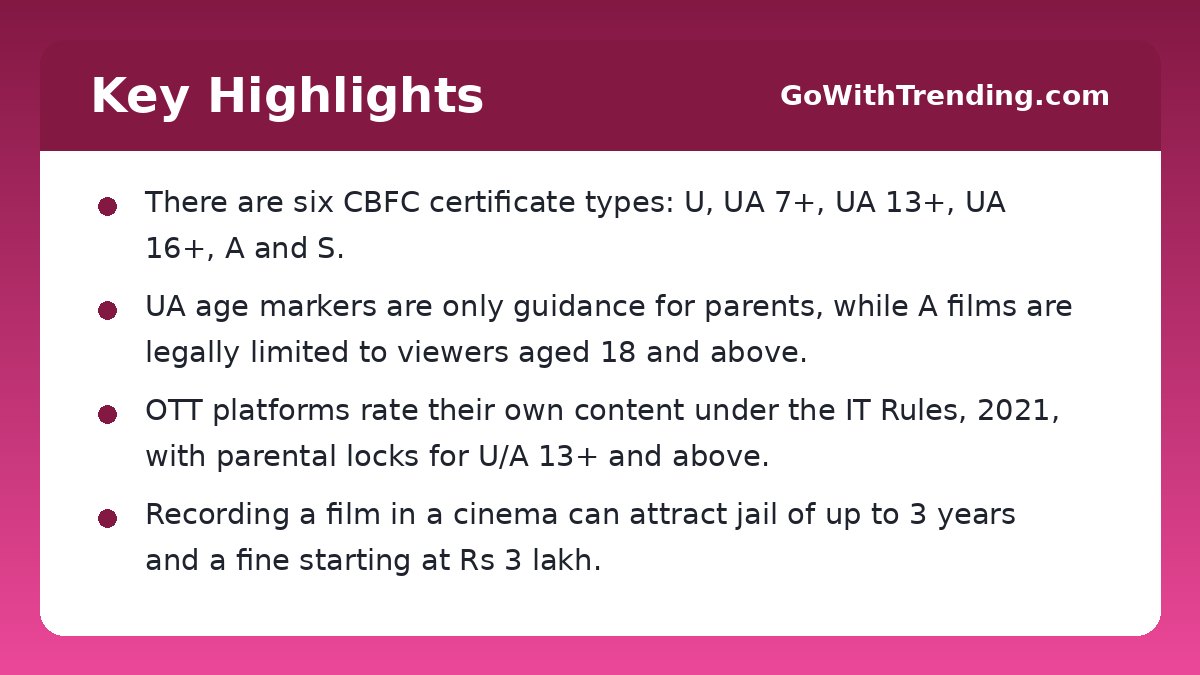
- There are six CBFC certificate types: U, UA 7+, UA 13+, UA 16+, A and S.
- UA age markers are only guidance for parents, while A films are legally limited to viewers aged 18 and above.
- OTT platforms rate their own content under the IT Rules, 2021, with parental locks for U/A 13+ and above.
- Recording a film in a cinema can attract jail of up to 3 years and a fine starting at Rs 3 lakh.
In This Article
What Is a CBFC Certificate?
The Central Board of Film Certification (CBFC), often called the censor board, is a statutory body under the Ministry of Information and Broadcasting. Under the Cinematograph Act, 1952, a film cannot be shown publicly in a cinema hall in India without a CBFC certificate. The Board watches the film, applies the official certification guidelines and then grants a category, sometimes after asking for cuts or changes.
The certificate is screened before the film begins, so the category and the certified length appear on the big screen. Distributors and cinemas also show the rating on posters, trailers and ticket-booking pages. You can learn more about the Board on its official website, cbfcindia.gov.in.
CBFC Certificate Types Explained: U, UA 7+, UA 13+, UA 16+, A and S
Until 2024, India had four categories: U, UA, A and S. The old UA rating used 12 years as the guidance age. The Cinematograph (Amendment) Act, 2023 and the Cinematograph (Certification) Rules, 2024 split UA into three age-based markers, which the Press Information Bureau described as replacing the single 12-year threshold.
| Certificate | Full meaning | Who can watch |
|---|---|---|
| U | Unrestricted public exhibition | Everyone, including young children |
| UA 7+ | Unrestricted, with parental guidance for children below 7 | Everyone; parents decide for children under 7 |
| UA 13+ | Unrestricted, with parental guidance for children below 13 | Everyone; parents decide for children under 13 |
| UA 16+ | Unrestricted, with parental guidance for children below 16 | Everyone; parents decide for children under 16 |
| A | Restricted to adults | Only viewers aged 18 and above |
| S | Restricted to a specialised audience | Only members of a stated profession or class, such as doctors or scientists |
What does UA 13+ mean in a movie?
UA 13+ is one of the most searched ratings. It means the film is open to all, but the CBFC suggests that parents or guardians judge whether a child below 13 should watch it. The same logic applies to UA 7+ and UA 16+, only with a different age. A UA 16+ film usually has stronger themes than a UA 7+ film, even though both carry the UA label.
Are the UA age markers compulsory?
No. The government has said clearly that the UA age markers are only recommendatory. They are meant for parents or guardians to consider, and a cinema is not required to stop a 12-year-old from entering a UA 13+ show. This is the biggest difference from an A film, where the restriction to adults is a legal condition of the certificate.
How to Use a CBFC Certificate Before You Watch
Knowing the six labels helps only if you check them at the right time. Follow these simple steps whenever you plan a family outing or a movie night.
- Check the CBFC certificate on the booking page. Ticket apps and cinema websites show the rating next to the film title, language and running time.
- Look at the trailer and poster. Official trailers usually carry the certificate at the start or end, along with the category letter.
- Read the age marker, not just the letters. UA 7+ and UA 16+ are very different, so note the number before deciding.
- Read reviews for the reason behind the rating. The certificate tells you the category, while reviews often mention violence, language or mature themes.
- Carry age proof for A films. Cinemas can ask for an ID to confirm that a viewer is 18 or older.
- Confirm the certificate on screen. The CBFC certificate slide shown before the film lists the category and certified length.
How the CBFC Decides a Film’s Category
The CBFC examines each film against certification guidelines issued by the central government under the Cinematograph Act. Examining committees look at the theme, the treatment, violence, language, drug use, sexual content and how scenes may affect children. The Board can grant a certificate as it is, suggest cuts or changes, or refuse certification.
In September 2026, the I&B Ministry notified revised film certification guidelines. Reports in ThePrint and Business Today say that films showing the use or trafficking of narcotic drugs must now carry a statutory anti-drug warning on screen. The UA 7+, UA 13+ and UA 16+ markers remain part of the system.
Since 2023, a CBFC certificate is valid for life, whatever its category. Earlier, a certificate was valid only for 10 years. The central government also no longer has power to revise a certificate already issued by the Board, in line with a Supreme Court judgment.
CBFC Certificate vs OTT Ratings
Many viewers confuse the CBFC certificate with the age ratings seen on streaming apps. The CBFC certifies films for cinema halls. Web series and films released directly on OTT platforms are not certified by the CBFC. Instead, the Information Technology (Intermediary Guidelines and Digital Media Ethics Code) Rules, 2021 ask platforms to classify their own content.
| Point | Cinema (CBFC) | OTT platforms (IT Rules, 2021) |
|---|---|---|
| Who rates | CBFC, before release | The platform itself (self-classification) |
| Categories | U, UA 7+, UA 13+, UA 16+, A, S | U, U/A 7+, U/A 13+, U/A 16+, A |
| Child safety tools | ID checks at the cinema for A films | Parental locks for U/A 13+ and above; age verification for A |
| Complaints | Through the CBFC process | Three-level grievance system, starting with the platform |
OTT platforms must show the rating and a content descriptor at the start of each title. If you want to know where a film is streaming after its theatrical run, read our report on the Jailer 2 OTT release for an example of how such releases are announced.
Can a Film Rated A Be Shown on TV?
Only films in the unrestricted category can be broadcast on television. The 2023 amendment therefore allows the CBFC to recertify an edited version of a film for TV. This is why a film with an A CBFC certificate may appear on a TV channel with several scenes trimmed or muted. The version you see on TV may differ from the theatrical cut.
Common Mistakes Viewers Make
- Treating UA as “adults only”. UA films are open to everyone; the age number is guidance for parents.
- Ignoring the age number. A UA 16+ film can contain much more intense content than a UA 7+ film.
- Assuming OTT shows are CBFC certified. Most streaming originals carry the platform’s own rating, not a CBFC certificate.
- Following old explainers. Many websites still describe UA as “below 12 with parental guidance”, which reflects the pre-2024 system.
- Taking children to A films. Cinemas can refuse entry to anyone below 18, so check the rating before booking.
What to Do If Something Goes Wrong
If a cinema denies entry to a minor for an A film, that is the rule working as intended, so check the rating before you book. If you believe a film or poster is being shown in violation of its certificate, you can raise it with the CBFC regional office or the local authorities, since the Cinematograph Act makes such exhibition an offence.
For OTT content, first complain to the platform’s grievance officer, who must decide within 15 days under the IT Rules. If you are not satisfied, the complaint can move to the platform’s self-regulatory body. Rules may change, so as of November 2026 always confirm the latest process on official websites such as mib.gov.in.
Final Thoughts
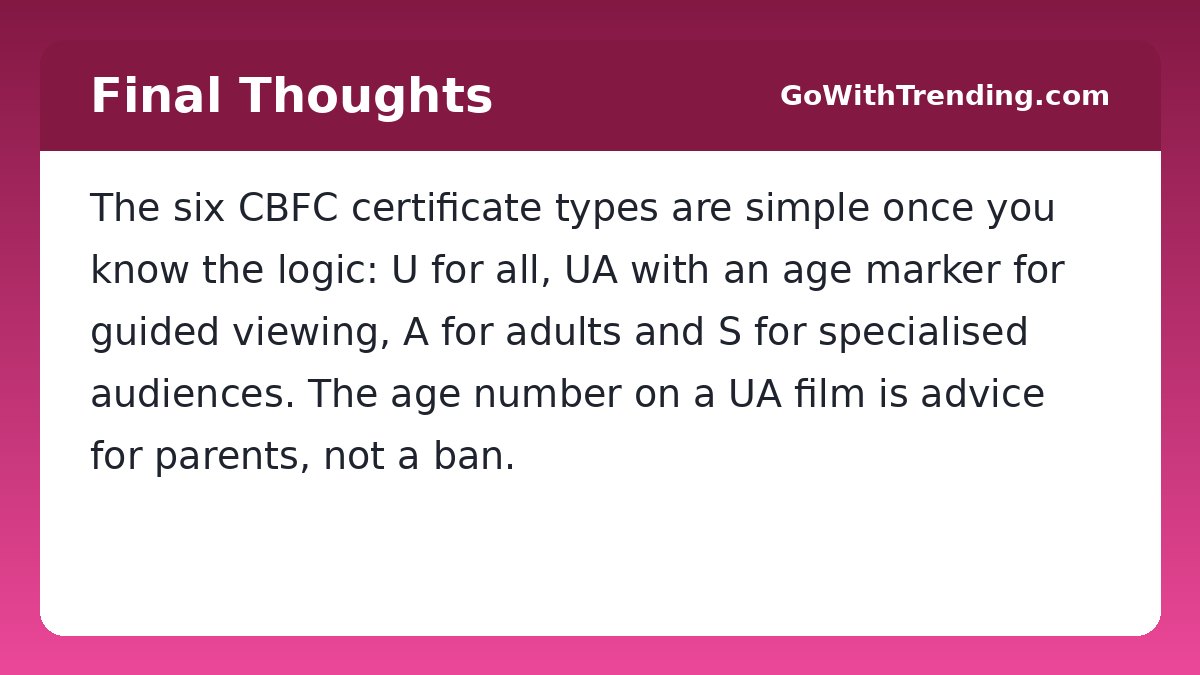
The six CBFC certificate types are simple once you know the logic: U for all, UA with an age marker for guided viewing, A for adults and S for specialised audiences. The age number on a UA film is advice for parents, not a ban.
Before your next cinema trip, check the rating on the booking page and the trailer. For streaming, use the platform’s own rating and parental lock. For more film news and explainers, visit our Ramayana box office report.
Sources
- PIB: Cinematograph (Certification) Rules, 2024 notified
- PIB: Parliament passes Cinematograph (Amendment) Bill, 2023
- PIB: IT (Digital Media Ethics Code) Rules, 2021
- ThePrint: CBFC's revised film certification guidelines
Frequently Asked Questions
Who issues film certificates in India?
The Central Board of Film Certification, a statutory body under the Ministry of Information and Broadcasting, headquartered in Mumbai with regional offices in several cities.
Does a CBFC certificate expire?
No. Since the 2023 amendment to the Cinematograph Act, a certificate is valid permanently. Earlier, it was valid only for 10 years.
What happened to the old UA 12 rule?
The single UA category with a 12-year guidance age was replaced by three markers, UA 7+, UA 13+ and UA 16+, under the 2024 rules.
Can the government change a certificate after the CBFC issues it?
No. The 2023 amendment removed the central government's revisional powers over certified films, following a Supreme Court judgment from 2000.
What is the penalty for recording a film in a cinema?
Under the 2023 amendment, unauthorised recording or online transmission of a film can lead to 3 months to 3 years in jail and a fine from Rs 3 lakh up to 5% of the audited gross production cost.
This article is based on publicly available reports at the time of publishing. Details can change as a story develops, so please check the linked sources for the latest updates.